
Running a trucking business involves much more than simply moving freight from one location to another.
Behind every successful delivery lies a mountain of administrative work, including load planning,
dispatching, paperwork, invoicing, driver communication, compliance management, route optimization,
and customer updates.
Many owner-operators and fleet owners spend countless hours every week handling these repetitive tasks
manually. Unfortunately, this often leaves less time to focus on what truly matters—growing the business,
improving customer relationships, and increasing profitability.
This is where a Transportation Management System (TMS) becomes a game changer.
A modern TMS automates routine operations, streamlines communication, improves visibility, and helps
trucking companies operate more efficiently. Whether you’re an owner-operator managing one truck or a
fleet manager overseeing dozens of vehicles, implementing the right TMS can easily save 10 or more hours
every single week.
In this guide, we’ll explore exactly how a Transportation Management System helps save time, reduce costs,
and improve overall trucking operations.
What Is a Transportation Management System
(TMS)?
A Transportation Management System (TMS) is software specifically designed to simplify and automate
freight transportation operations. Instead of juggling spreadsheets, phone calls, emails, and paperwork, a
TMS centralizes everything into one easy-to-use platform
- Load planning
- Dispatch management
- Driver communication
- Route optimization
- Document management
- Rate confirmations
- Broker communication
- Customer tracking
- Invoice generation
- Reporting and analytics
- Fleet management
- Compliance records
For trucking companies working with a trusted logistics partner like PicknMoveDispatch.com, a TMS
becomes the backbone of daily operations
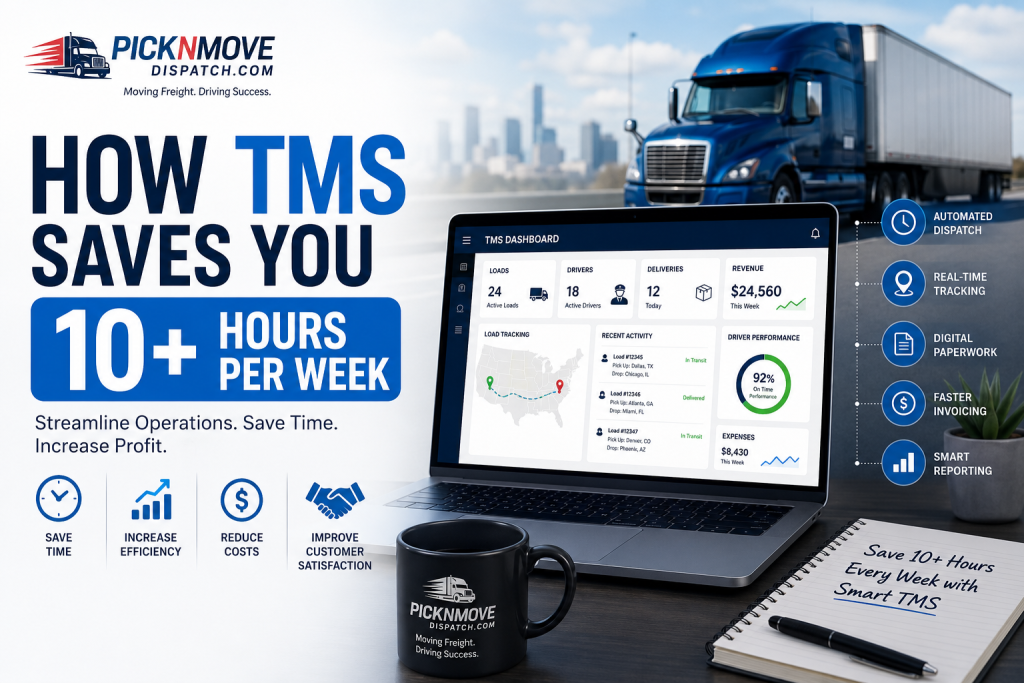
Why Trucking Companies Lose So Much Time
Before understanding how TMS saves time, let’s look at where trucking businesses commonly waste it.
Manual Load Entry
Dispatchers often copy load details from emails into spreadsheets or other software.
Estimated weekly time: 2–3 hours
Driver Communication
Calling and texting drivers for location updates consumes valuable hours.
Estimated weekly time: 2 hours
Paperwork
Rate confirmations, BOLs, PODs, invoices, permits, and receipts all require organization.
Estimated weekly time: 2–4 hours
Route Planning
Finding the best routes while avoiding traffic, tolls, and delays requires constant monitoring.
Estimated weekly time: 1–2 hours
Billing and Invoicing
Creating invoices manually after every completed load takes significant effort.
Estimated weekly time: 1–2 hours
Combined together, these routine tasks often exceed 10 hours every week
How TMS Saves You More Than 10 Hours Every
Week
- Automated Dispatching
One of the biggest advantages of a Transportation Management System is automated dispatch
management.
Instead of repeatedly entering load details, dispatchers can assign loads with just a few clicks.
Benefits include:
- Faster load assignment
- Instant driver notifications
- Reduced phone calls
- Centralized dispatch dashboard
- Real-time updates
2-Centralized Driver Communication
Without a TMS, dispatchers spend much of the day calling drivers for updates.
A TMS allows drivers to
- Receive load information instantly
- Share GPS location
- Upload documents
- Report delivery status
- Send messages directly
3- Automated Paperwork Management
Paperwork is one of the most time-consuming aspects of trucking.
A TMS stores
- Bills of Lading
- Proof of Delivery
- Rate Confirmations
- Insurance documents
- Driver documents
- Permits
- Fuel receipts
Instead of searching through emails or folders, everything is organized automatically.
Time saved: 2 hours weekly
4- Faster Invoice Creation
Manual invoicing slows down cash flow.
A TMS can automatically generate invoices using completed load information.
Advantages include
- Fewer billing mistakes
- Faster payments
- Better record keeping
- Improved cash flow
5- Route Optimization
Fuel is one of the largest operating expenses for trucking companies.
Modern TMS software recommends the most efficient routes by considering:
- Traffic
- Weather
- Road restrictions
- Toll costs
- Delivery schedules
- Instant Load Tracking
Customers increasingly expect real-time shipment visibility.
Instead of making multiple phone calls, dispatchers can simply share tracking information directly through
the TMS.
Advantages include
- Improved transparency
- Better customer experience
- Reduced phone interruptions
7- Better Reporting
Creating reports manually often takes hours.
A Transportation Management System automatically generates reports such as
- Revenue reports
- Driver performance
- Fuel usage
- Delivery times
- Fleet utilization
- Profit margins
Who Should Use a Transportation Management
System?
A TMS is valuable for businesses of all sizes, including:
- Owner-operators
- Small trucking companies
- Medium-sized fleets
- Large carriers
- Freight brokers
- Logistics providers
- Dedicated dispatch companies
Whether you operate one truck or hundreds, the efficiency gains can have a significant impact on your
bottom line.
Why Choose PicknMoveDispatch.com?
At PicknMoveDispatch.com, we understand the daily challenges faced by trucking companies. Managing
loads, paperwork, driver communication, compliance, and customer expectations can quickly become
overwhelming without the right systems in place.
Our Transportation Management Services are designed to simplify operations and help carriers focus on
what they do best—keeping trucks moving and freight delivered on time.
When you partner with PicknMoveDispatch.com, you benefit from
- Professional dispatch support
- Transportation Management System solutions
- Load management
- Driver coordination
- Real-time shipment tracking
- Paperwork assistance
- Invoice support
- Fleet optimization
- Dedicated customer service
- Efficient workflow management
Our goal is to help trucking businesses reduce administrative burdens, improve operational efficiency, and
maximize profitability through reliable transportation management.
Frequently Asked Questions
How much time can a TMS actually save?
Most trucking businesses save 10 to 15 hours per week, depending on fleet size and the number of
manual processes being replaced.
Is a TMS only for large trucking companies?
No. Even owner-operators and small fleets benefit from improved organization, automation, and time
savings.
Can a TMS help reduce operating costs?
Yes. Route optimization, automation, and fewer manual errors contribute to lower fuel costs, reduced
administrative expenses, and improved overall efficiency.
8
Does a TMS improve customer service?
Absolutely. Real-time tracking, faster communication, and more accurate delivery updates create a better
experience for customers and brokers alike
Final Thoughts
Time is one of the most valuable resources in the trucking industry. Every hour spent on manual paperwork,
repetitive phone calls, or administrative tasks is an hour that could be used to find better loads, improve
customer relationships, or grow your fleet.
A modern Transportation Management System (TMS) eliminates unnecessary work by automating
dispatch, streamlining communication, organizing documents, optimizing routes, and simplifying invoicing.
The result is a more productive operation that can save 10 or more hours every week while improving
accuracy, customer satisfaction, and profitability.
If you’re ready to streamline your trucking operations and spend less time managing paperwork and more
time moving freight, PicknMoveDispatch.com is here to help. Our transportation management expertise
and dedicated support can help you operate more efficiently, reduce administrative burdens, and keep your
business moving forward.